



Power BI Client Access Without Pro Licenses | Fabric Guide
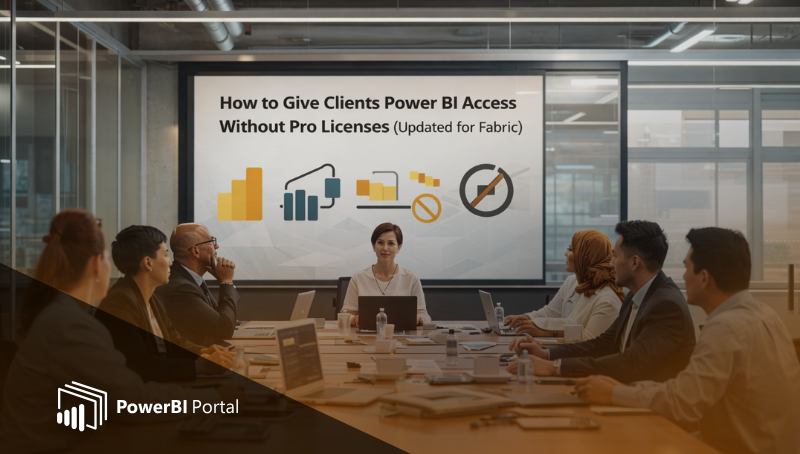
Providing clients with access to Power BI reports without requiring individual Pro licenses is one of the most common challenges consultancies face.
As client bases grow, asking every external user to purchase a Power BI Pro license quickly becomes expensive, complex, and difficult to scale. With Microsoft Fabric now central to modern analytics architectures, the available options for delivering client access have evolved and understanding them is essential.
In this article, we explore the best ways to give clients access to Power BI reports without Pro licenses, while maintaining performance, governance, and cost control.
Why Power BI Pro Licenses Don't Scale for External Clients
Power BI Pro licensing works well for internal collaboration. However, when delivering analytics to external users, it creates several operational hurdles. Because data protection is not optional, organizations often find themselves over-spending on licenses just to maintain security protocols.
The primary challenges include:
- High per-user licensing costs as the user base expands.
- Administrative overhead for managing guest users in Azure Active Directory (Entra ID).
- Friction in sales conversations when clients are forced to manage their own Microsoft licensing.
- Dependency on the client's internal IT departments to provision accounts.
In many scenarios, clients simply want access to dashboards inside a branded portal or application without managing Power BI accounts or licenses. This is where alternative models become essential.
Option 1: Power BI Embedded for External Users
One of the most effective ways to provide Power BI access without Pro licenses is through Power BI Embedded.
This allows organizations to integrate dashboards and reports directly into a custom application, client portal, or website. Instead of licensing each external user individually, you license capacity and manage access centrally through a master account or Service Principal.
Key advantages of Power BI Embedded:
- No Pro licenses required: External users view reports via the embedded capacity.
- Centralized management: You maintain full control over who sees what data.
- Seamless UX: Reports appear natively within your own software or portal.
- Scalability: You can scale Power BI Embedded without performance issues as your client list grows.
This model is particularly powerful for consultancies delivering analytics as a service, as it decouples the reporting functionality from the Microsoft 365 license requirements of the end client.
Option 2: Capacity-Based Licensing (Premium or Fabric Capacity)
Another alternative is capacity-based licensing, where the organization pays for dedicated compute resources instead of individual user "seats." This is increasingly relevant as more companies migrate to Microsoft Fabric.
Fabric unifies data engineering, data warehousing, and Power BI within a single environment. By understanding Power BI capacities, organizations can deliver reports to large audiences more predictably. When choosing between Power BI Embedded vs Fabric Capacities, you must consider whether your goal is strictly embedding (A-SKUs) or a broader workspace experience (F-SKUs).
| Feature | Power BI Pro | Power BI Embedded | Fabric Capacity |
| Cost Model | Per User / Month | Per Hour (Capacity) | Per Hour (Capacity) |
| External License Needed? | Yes | No | No (within specific SKUs) |
| Best For | Internal Teams | ISVs & Portals | Enterprise Analytics |
| Scalability | Linear Cost Growth | High / Dynamic | High / Unified |
Alternative: Automating Distribution to Eliminate
Licenses
Microsoft Fabric introduces a more integrated analytics ecosystem. Instead of For clients who do not need an interactive live dashboard every second of the day, automation can bypass the need for Pro licenses entirely. Tools like PowerBI Robots act as a bridge, delivering snapshots of reports directly to client inboxes, SharePoint sites, or FTP servers.
You can automate Power BI report distribution in 5 simple steps, ensuring clients receive the data they need in PDF, Excel, or Image format. This has helped many firms move from 3 days to 3 hours when generating monthly reports. Recent updates even support Service Principal authentication, making the setup more secure and license-efficient.
Microsoft Fabric and the Future of External Power BI Access
Microsoft Fabric introduces a more integrated analytics ecosystem. Instead of treating Power BI as a standalone reporting tool, Fabric positions it within a broader data platform. For organizations delivering analytics externally, this means better control over data pipelines and simplified architecture for large deployments.
Choosing the right licensing model depends on user volume, concurrency patterns, and performance requirements. For many consultancies, combining embedded analytics with a structured portal offers the most flexible solution.
Solutions like PowerBI Portal help centralize client access, manage capacity efficiently, and deliver Power BI reports securely without requiring Pro licenses for every user. This approach ensures that your costs remain tied to usage and capacity rather than being penalized for every new client you onboard.
Conclusion
Requiring every client to purchase a Power BI Pro license is rarely the most scalable solution.
By leveraging Power BI Embedded, capacity-based licensing, and Microsoft Fabric, organizations can deliver high-quality analytics to external users while maintaining cost control and governance.
The key is choosing a licensing model aligned with scale not defaulting to per-user Pro licenses.
👉 Ready to deliver Power BI reports to clients without the Pro license headache? Book a demo.

Share this post: