

How to Scale Power BI Embedded Without Performance Issues
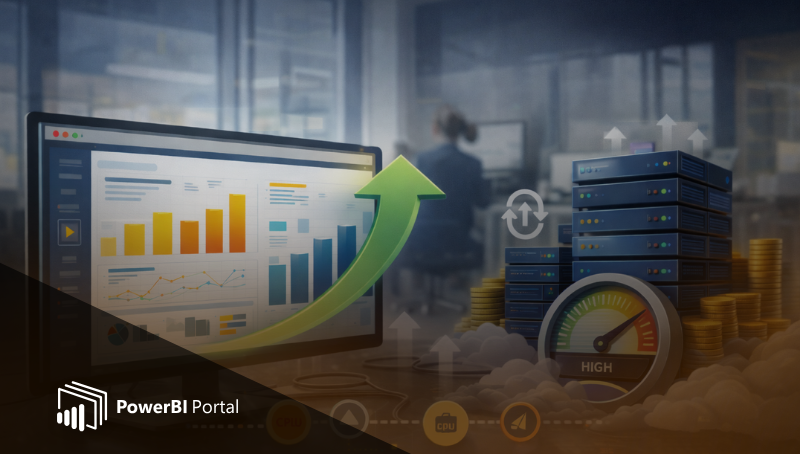
A practical guide to capacity planning, report optimization, and cost control
Power BI Embedded is a powerful way to deliver analytics inside applications and client-facing portals. But as usage grows, many teams struggle with performance bottlenecks, slow dashboards, and rising infrastructure costs.
Scaling Power BI Embedded successfully requires more than simply adding capacity. It demands a clear understanding of how performance is affected by capacity usage, report design, concurrency, and scaling strategies.
This guide explains how to scale Power BI Embedded without performance issues, while keeping costs under control and user experience consistent.
Why Performance Degrades as Power BI Embedded Scales
Performance issues rarely appear on day one. They usually emerge when:
- The number of concurrent users increases
- Reports grow in complexity
- Data volumes expand
- Usage patterns become unpredictable
When this happens, dashboards may take longer to load, interactions become slower, and refresh times increase. Understanding why this happens is the first step to fixing it.
Understanding Power BI Embedded Capacity and Its Limits
Power BI Embedded relies on dedicated capacity to process queries, render visuals, and handle concurrent usage. When capacity is under-dimensioned or poorly managed, performance naturally suffers.
Common capacity-related challenges include:
- Peaks of concurrent users exceeding available resources
- Heavy reports consuming disproportionate capacity
- No visibility into real usage patterns
Monitoring capacity metrics is essential. Without it, teams are often reacting too late, after users already experience slow performance.
Key metrics to monitor include:
- CPU and memory utilization
- Query wait times
- Concurrent user load
- Dataset refresh impact
Understanding these signals helps teams decide whether to scale, optimize, or redesign.
Report Optimization: The Hidden Performance Multiplier
Capacity alone is rarely the root cause of performance problems. In many cases, inefficient report design is the real bottleneck.
Poorly optimized reports consume far more resources than necessary, affecting every user on the same capacity.
Best practices for report optimization include:
- Simplifying data models
- Removing unused columns and tables
- Reducing complex DAX calculations
- Using aggregations where possible
- Limiting visuals per page
Optimized reports not only load faster but also make better use of capacity, delaying or even eliminating the need for costly scale-ups.
Using Caching, Pre-Aggregation, and Auto-Scaling
To scale Power BI Embedded efficiently, teams should reduce unnecessary real-time processing.
Caching and Pre-Aggregation
Caching and pre-aggregated datasets minimize the number of queries executed against live data, significantly improving response times and reducing capacity load.
This is especially valuable for:
- High-traffic dashboards
- Frequently accessed summary views
- Client-facing portals with predictable usage patterns
Auto-Scaling
Auto-scaling allows capacity to increase during peak usage periods and scale down when demand drops. This ensures consistent performance without paying for unused resources.
When configured correctly, auto-scaling becomes a key tool for balancing performance and cost.
Scaling Power BI Embedded the Right Way
The most successful Power BI Embedded environments combine three pillars:
- Continuous monitoring to understand real usage
- Report and model optimization to reduce unnecessary load
- Intelligent scaling strategies to adapt to demand
When these elements work together, organizations can scale Power BI Embedded confidently, delivering fast, reliable analytics experiences even as user numbers grow.
How PowerBI Portal Helps You Scale Power BI Embedded
PowerBI Portal is designed to help organizations manage Power BI Embedded at scale by providing:
- Controlled access to reports and users
- Centralized capacity governance
- Better visibility into usage patterns
- Secure, scalable client-facing analytics delivery
Instead of reacting to performance issues, teams gain the tools to prevent them.
👉 Book a demo and see how PowerBI Portal helps you scale Power BI Embedded without performance or cost surprises.

Share this post: